

CHARAL 2026

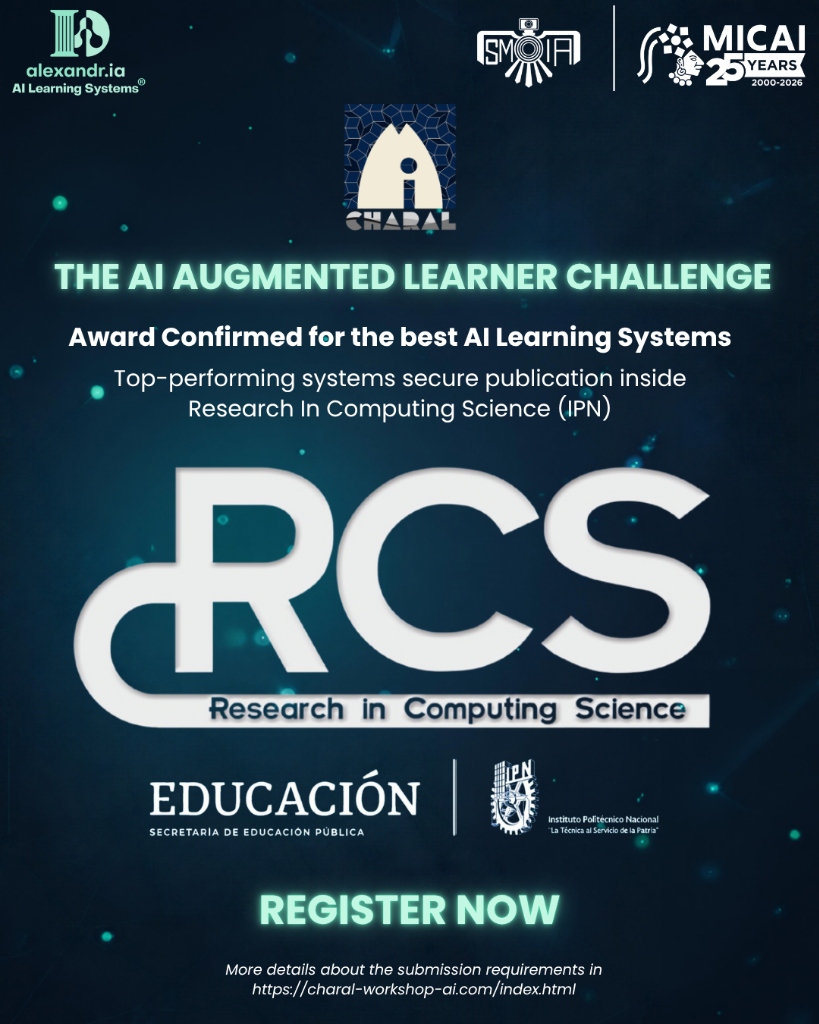
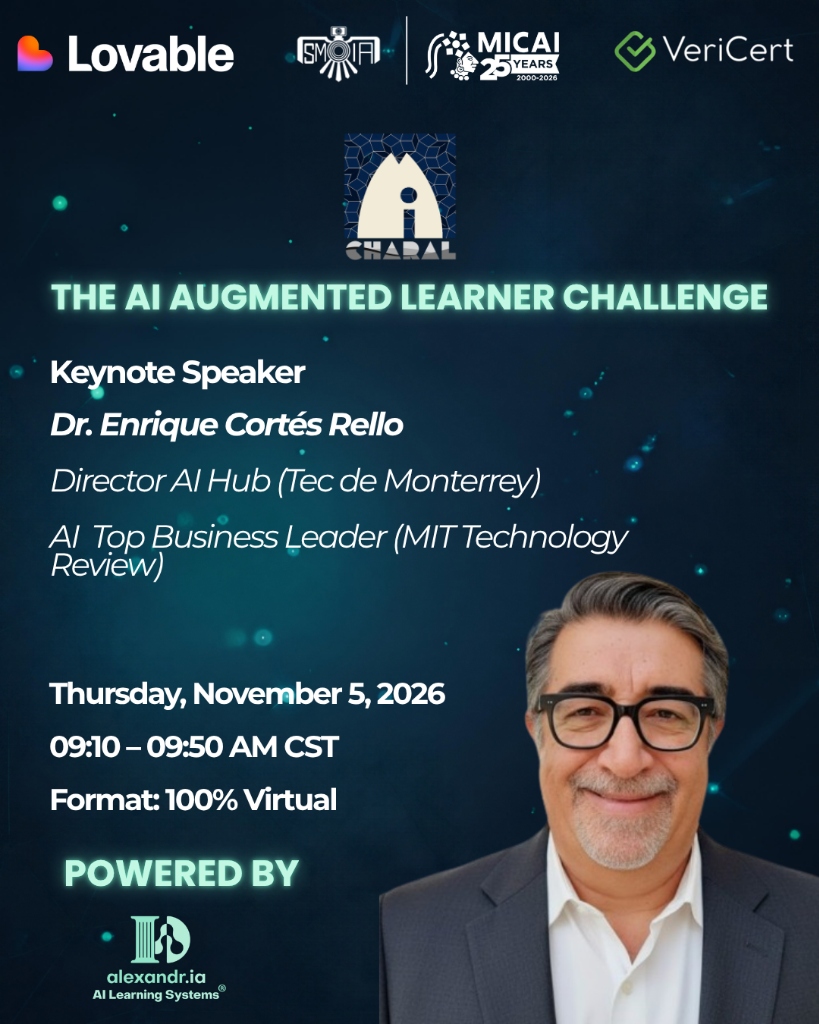
Cognition First: The AI Augmented Learner Challenge

"From detecting AI use to demanding higher-order critical thinking"

Challenge at MICAI 2026

Date: To be announced (MICAI 2026 takes place November 2–6, 2026)

Location: Tecnológico de Monterrey, Campus Chihuahua, Mexico

Format: To be announced

See how to submit a prototype

About the Challenge

The Cognition First: The AI Augmented Learner Challenge Committee invites educators, researchers, faculty members, graduate and undergraduate students, innovators, entrepreneurs, and industry professionals to submit prototypes for presentation and evaluation during the challenge.

This challenge aims to promote the design, build, and deployment of AI-powered systems and technical prototypes that evaluate and elevate human cognitive processing. Instead of treating AI as a shortcut, these systems must interact with, audit, and/or evaluate the learner or researcher to ensure that critical thinking and deep reasoning are actively increasing. The initiative seeks to shift the educational paradigm from detecting AI use to demanding higher-order critical thinking when AI is used, enforcing rigorous engineering standards and foundational data governance.

Tracks

Track 1 — AI Systems for Reviewers

AI systems that empower educators and research reviewers to evaluate the depth of human cognition, shifting focus from grading final outputs to auditing reasoning and synthesis.

Track 2 — AI Systems to Stimulate Cognition

AI systems that empower learners and researchers by challenging thinking in real-time, preventing passive AI reliance by demanding reflection, synthesis, and deep reasoning.

Prototype Presentation & Evaluation

Accepted participants will be invited to present a working prototype, demonstrator, or proof of concept during the challenge showcase sessions. Presentations should clearly communicate:

Target User

Students, educators, researchers, thesis review boards, journal reviewers.

Cognitive Focus

How the system measures or stimulates deep reasoning, reflection, or source verification rather than passive AI reliance.

System Architecture

How underlying LLMs, agents, RAG pipelines, or reasoning architectures evaluate human thought process.

Governance & Integrity

How data privacy is maintained, guarding against automated grading bias, and ensuring human-in-the-loop oversight.

Technical Viability

Reproducibility, documentation, and readiness for academic deployment.

As a distinctive feature of this challenge, accepted prototypes will participate in a formal user interaction evaluation process where judges and evaluators will directly interact with the systems, following a standardized protocol designed by Alexandr.ia AI Learning Systems.

As a provisionally planned distinction (pending final logistical confirmation), top-performing prototypes may receive access to a live sandbox environment hosted by Alexandr.ia AI Learning Systems to further test, validate, and scale their solutions.

Evaluation focuses on originality and innovation, relevance and pedagogical impact, AI & ethical governance, prototype and technical maturity, and quality of presentation and documentation. Participants receive a summary report with aggregated evaluation results and recommendations for improvement.

Submission Requirements

Authors must submit through the challenge portal, selecting the proper track, the following:

Functional System Prototype

A live, accessible web URL showcasing a working version of the application.

GitHub Repository Codebase

Full source code containing the end-to-end stack, architecture diagram, and deployment instructions.

5-Minute Demo & Pitch Deck

A 5-minute video demonstrating system functionality paired with a slide deck highlighting the core solution.

System Prompt, Ethical & Data Governance Document

A 3–5 page document detailing system prompts and few-shot prompts, guardrails and human-in-the-loop controls, PII privacy and bias mitigation, and human oversight and hallucination controls.

Submission portal — coming soon

Review Process

All submissions undergo peer review based on the following weighted criteria. Accepted submissions are included in the conference and scheduled for a live demonstration.

Criterion Weight
Originality and Innovation25%
Relevance and Pedagogical Impact25%
AI & Ethical Governance20%
Prototype and Technical Maturity15%
Quality of Presentation and Documentation15%

Awards

Track 1 Winner

Best Reviewer Tool

Track 2 Winner

Best Learning Companion

Best AI Governance & Ethics

Best Social Impact

Demo Showcase Chairs

For inquiries regarding prototype submissions, evaluation procedures, or participation requirements, please contact:

Eugenio Salas Iturriaga

Demo Showcase Chair

Arturo Gomez Chavez, PhD

Demo Showcase Chair